Discover our exquisite collection of emeralds, meticulously sourced to meet your specific needs and budget. Shop online now for worldwide delivery. Secure your perfect emerald today!
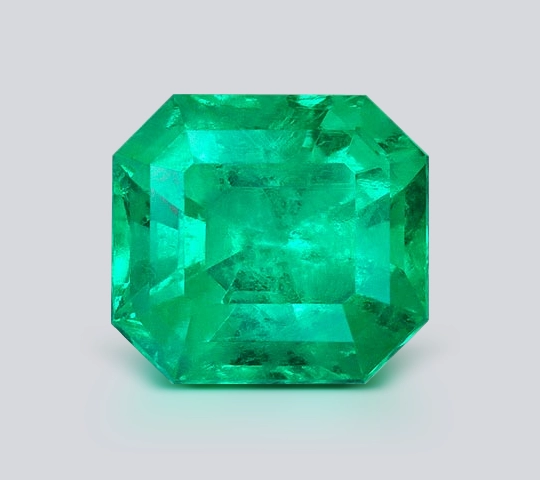
Emerald is a variety of natural beryl, differing in its green color. Together with sapphires and rubies, it is one of the three most expensive colored gemstones. Natural emerald delights with its pure bluish-green coloring, unmatched by any other gemstone.
The rich green coloring is due to the presence of chrome admixtures. The admixture of vanadium gives the stone a bluish hue, and the presence of iron ions makes it a warm, yellowish color. Natural stones are divided into those tinged with chrome and those tinged with iron and vanadium. If the green coloring of beryls is due to iron ions, these minerals are called green beryls. The greenish hues of these minerals are less noticeable and differ from the grass-green hues of emeralds. The richer colors of green beryls are becoming sought after by jewelers for their collections.
Emeralds have a high hardness, defined as 7.5 to 8 on the Mohs scale. This quality contributes to the durability and excellent wear resistance of stones included in jewelry. The peculiarity of the natural samples is the presence of many inclusions and small cracks. This peculiarity decreases the durability, making the work of the setters and cutters more complicated.
The main parameters determining the price are color, clarity, and weight. Natural minerals with a saturated color are rare. The discovery of clean, large stones over 5-6 carats is considered a unique event. Such pieces can reach the price of diamonds of the same size. Traditionally, clarity is determined by the eye without optical instruments
During an evaluation, attention is also paid to color zoning since minerals have colored areas of different intensities. Over-expressed zoning lowers the price of a stone. A high-quality cut reveals the color palette of the emerald and may hide various natural traits, such as pleochroism, zoning, and inclusions. In the jewelry markets, the price of high-quality emeralds is $6,000 to $8,000 per carat. As for the top-end emeralds, they are worth over $10,000 per carat.
Often emeralds are treated with gem cutting, which significantly impacts the price. One uses impregnation with cedar oil, resins, polymers, dye oil, or paraffin during the decoration. Of course, the price of natural stones is much different from the ennobled specimens. Only specialized gemological laboratories can tell if the stone has been ennobled. It should be noted that all jewelry companies accept oiling with cedar oil with a similar refractive index as a standard procedure.
Russian laboratories use the TU 1988 to evaluate the color and purity of emeralds. This document states that the color and quality parameters are determined according to the samples under certain conditions. The color is determined according to a 5-ball scale, where one corresponds to the richest shade and 5 to the lightest tone. The samples that turn out to be lighter than the scale's five mark are referred to as beryls. Specially certified samples are used to determine colors. A 5-mark scale also defines purity. The cleanest stones with no inclusions are referred to as the first group. Group K2 includes stones with many visible inclusions. The names of the groups K1 and K2 show that emeralds of this quality are suitable for cut into cabochons.
The international color grading is based on the GIA system. It is performed by the special color set GIA GemSet (vsbG-G, tone 3-8, saturation 2-5). Purity is evaluated in 3 groups. According to the GIA GemSet, the best color is bG 5/5. The best clarity group is III.
Natural emeralds can have certain varieties. The first one is caused by many elongated needle-like inclusions and is called "cat's eye. The second kind is called trapiche. It is an unusual star-shaped arrangement of six sectors separated by graphite inserts. Trapiche emeralds, found in Colombia, are a valuable prize for collectors worldwide. Stones of this kind are rarely found in high quality, which multiplies the value of the specimens.
Modern mining is done in hundreds of deposits located in different countries. The richest deposits are said to be located in Colombia. They account for 55 to 70% of world production in different years. Jewelers refer to Colombian emeralds as the reference samples with their high quality and color palette, which makes Colombian stones a world-class brand. But not all Colombian finds are of high quality. Now, many samples from Brazil and Africa may be of higher quality. Along with Colombia, they are also found in Brazil (Minas Gerais), Zimbabwe, Madagascar (Malagasy), the United States (North Carolina), South Africa, Nigeria, Austria (Habahtal), and Russia (Urals).
Jewelry decorated with emeralds is one of the most popular in the world. The ancient representatives of the nobility gave the emerald jewelry the most honorable places. The rich green hues are in great demand even nowadays. The cost of the jewelry varies quite a lot. The price of traditional gold rings with a small stone of medium quality lies within a few hundred dollars. Jewelry pieces graced with high-quality, large-size emeralds cost tens of thousands of dollars.
The most common way to set precious emeralds in gold is to make rings or earrings. Silver is rarely used. Many jewelers use a combination of emeralds and small diamonds to frame the green stone. The most popular choice for jewelry pieces is the one with a stone that has a medium shade of color. A jewelry piece with such an emerald can be worn at work or a social gathering. There is practically no jewelry piece with stones over 3 carats in the showcases of jewelry stores. These pieces of jewelry are mainly made to order. The major stipulation is the selection of quality emeralds. Finding a pair of similar stones for women's earrings is quite tricky. Coming into fashion are men's rings and rings with an emerald. Almost all world-class jewelry houses produce jewelry with precious green minerals.
GEMSTOCK.ORG COMPANY LIMITED, Tax ID: 0105561148825
919/1, Jewelry Trade Center, 2nd Floor, Room No. 201, Si Lom Road, Si Lom Sub-district, Bang Rak District, Bangkok, Thailand 10500
+66613953588