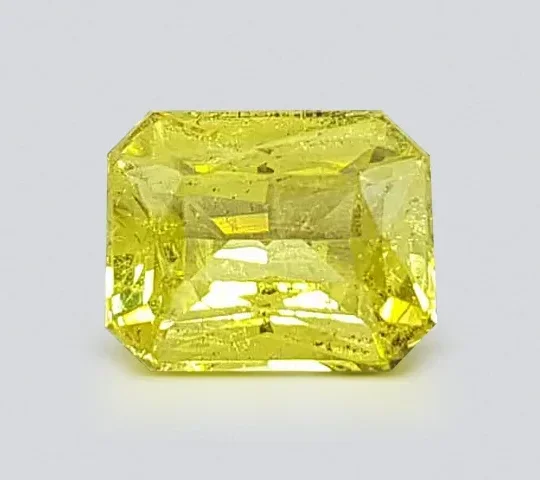
The mineral chrysoberyl is not very well known on its own. But its jewelry variety, alexandrite, is known to all without exception. Discovered in Russia in the Urals in the 1830s, alexandrite was named after the future Emperor Alexander II. Alexandrites are considered to be one of the rarest gemstones.
The alexandrite is the best-known variety of chrysoberyl and is best known for its color-changing effect, known as the "alexandrite effect". In daylight the stone takes on a bluish-greenish hue, and in artificial light it becomes pinky-red. The color change in alexandrite is caused by the addition of chrome in the mineral's structure, and the degree of saturation and contrast of the transition of color is called reverse. The stronger is the reverse, the richer is the hue, the higher is the price of the stone.
Besides alexandrite, the other variety of chrysoberyl with the cat's eye effect, cymophane, is also well-known. As a rule, cymophane is pale yellow, golden, or light green. The cat's eye effect is caused by the parallel channels that are located in the stone. When this kind of stone is cut into a cabochon (a hemispherical cut), a white stripe appears on its surface and moves across the channels as the stone shakes. The cat's eye alexandrites are extremely rare. Because of their uniqueness, such stones are highly prized. For example, alexandrites with such effect are often found in the Tanzanian deposits
The most valuable are the Ural alexandrites, due to their bright color transitions and the historical significance of the deposit. However, during this and the past centuries, the gems from the Malyshevo deposit is not of very high quality, with good reversion, but very low purity, sometimes even completely opaque. Also alexandrites from Brazil are highly prized, they have good reversion and high purity, but recently they are not very numerous on the world market. The global market mainly consists of alexandrites mined in Sri Lanka.
For high-quality, natural alexandrite with a strong color change and minimal inclusions, prices can range from several thousand dollars per carat to tens of thousands of dollars per carat. Larger stones, those over 2-3 carats, are especially rare and can command even higher prices.
GEMSTOCK.ORG COMPANY LIMITED, Tax ID: 0105561148825
919/1, Jewelry Trade Center, 2nd Floor, Room No. 201, Si Lom Road, Si Lom Sub-district, Bang Rak District, Bangkok, Thailand 10500
+66613953588
